
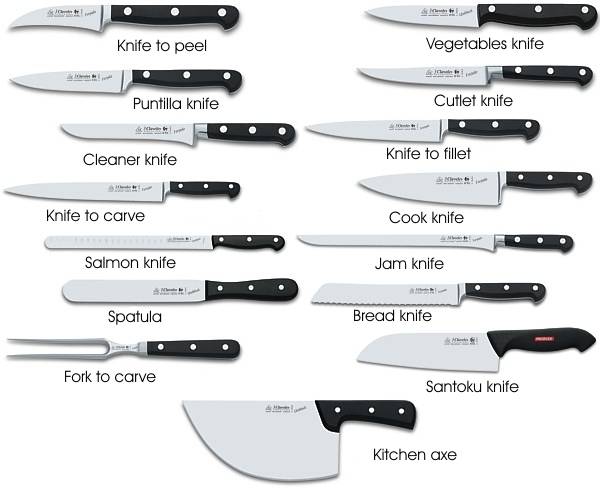
Contrary to what some of us may believe, kitchen knives are not divided into two basic types - sharp or dull. In reality, kitchen knives are to the kitchen what handsaws are to a woodworking shop. There are numerous types of kitchen knives, each with their own purpose and design. In the same way you wouldn't use a chainsaw to trim a picture frame, you wouldn't use a meat cleaver to peel potatoes, for instance. Each blade performs a specific task, so knowing the different types of kitchen knives can help a cook work more efficiently and safely.
One of the most common kitchen knives used today is called a chef's knife. A chef's knife is used for many of the most basic food preparations tasks in the kitchen. It can chop through most vegetables and fruits, slice through meats and cheeses, and create a fairly fine mince or dice.
Chef's knives are usually sold in different sizes, although the largest and smallest sizes still perform the same tasks well. The different sizes are used to match the size of the knife with the size of the user's hand. Larger chef's knives can be harder to control if you have smaller hands, so be sure to test the grip of any knife for comfort before you add it to your collection.
Another variety of kitchen knife is the carving knife. A carving knife is generally larger than a chef's knife, although their basic shapes can be similar. A carving knife can be very rigid or very flexible, depending on the type of meat it is designed to carve. Carving a large pot roast may require a very rigid blade, while carving pork or fish steaks may require more flexibility. A carving knife is often accompanied by a large two-pronged tool called a carving fork.
On the smaller end of the kitchen knives spectrum is the paring knife. A paring knife's blade is rarely more than four inches long (about 10 cm), making it ideal for peeling and coring fruits and vegetables. A paring knife is also used to create special garnishes and other decorative elements. A paring knife's blade should be kept very sharp to prevent accidents. A dull paring knife can cause the user to place too much pressure on the blade, leading to slips and cuts.
Some kitchen knives are designed to prevent food preparation disasters. Many people find slicing through a loaf of bread to be an exercise in futility. This is why many cooks keep a long serrated knife on hand.
A serrated knife works much like a crosscut saw in woodworking. Instead of slicing through the hard crust and soft interior of a bread loaf, a serrated knife's blade makes a series of short saw cuts instead. Without the serrations, a regular knife blade would slide smoothly across the top of the crust without penetrating it. Some fibrous vegetables and fruits also benefit from a serrated knife's crosscutting design.
For removing bones from meats, many cooks uses narrow-bladed kitchen knives called boning knives. A boning knife is usually larger than a paring knife, with a rigid blade that tapers off to a point. It is used to carve out any remaining bones in red meats or to completely debone a whole chicken. A boning knife's narrow blade allows the user to cut around bones without excessive waste. A cousin to the boning knife, called a filet knife, is much more flexible and allows the user to remove skin from fish.
One of the largest kitchen knives is the cleaver. A cleaver has a very heavy, thick blade for cutting through the thickest portions of meat or bones. Despite its imposing size, however, it can also be used for fine chopping and dicing. Cooks can also use the flat side of a cleaver to crush garlic cloves, whole spices or seeds. A cleaver's flat blade can also be used to transfer chopped ingredients to the cooking area.
Other kitchen knives are more specialized, but they all serve a purpose. An oyster knife can penetrate the hard shell of oysters and clams and slice through the tendons holding the sections together. A deveining knife has a small, thin blade designed to remove the gritty vein found in raw shrimp, while simultaneously slicing through the shell. Other specialty knives help process grapefruits, slice through hard cheeses, open clam shells, and even carve steam holes for chestnuts.
 Many people just moving into their own places for the first time, or newlyweds setting up a kitchen, may be overwhelmed by the array of kitchen tools available. It seems that there is a tool for almost any job, and picking the right ones seems impossible. Does the person rely on the kinds of spatulas Mom always used, or should he or she think about something new? Some kitchen tools are indispensable, and should be purchased first. Then, the person can go ahead and look for interesting gadgets.
 If you are planning to put together a beautiful cheese plate, check out The Cheese Board Collective in Berkeley. Their selection of local and international cheeses cannot be beat, and their prices are by far the best I have found.
 Bunn has been synonymous with great coffee for decades. Ever since their introduction in 1963, Bunn coffee machines have set the standard for commercial pour-voer coffee systems. Bunn has been an innovator in the coffee industry since 1957 when they started making a revolutionary paper filter. They were already well-known in the coffee and restaurant industry when they introduced the Bunn Model X, the very first Bunn coffee machine. In 1973, Bunn made coffee history again with the first drip coffee maker for home use. Their home drip coffee maker started a revolution in the industry and for the past forty years, drip coffee makers have held the largest market share of all types of coffee makers in home use.
 Diet plans are essential for leading a fit and healthy life. There are various diet plans that you can select, based on your requirements.
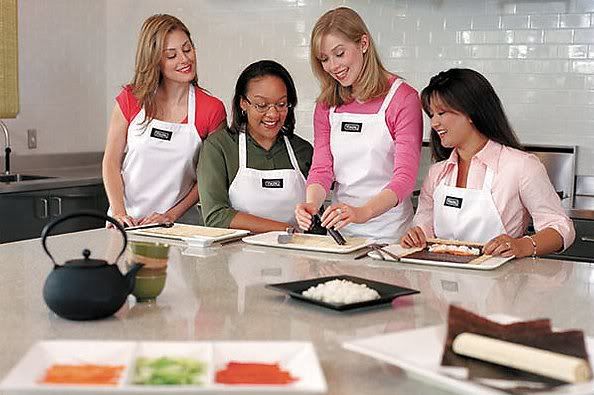 If you find yourself cooking for friends, being asked to cook a special dish for a family gathering, cooking in your spare time just for the fun of it, or heading for the cookbook aisle of the local library or book store, then cooking school may be your cup of tea. Take the initiative and get started on the road to becoming a chef.
 Before yogurt makers camealong, making homemade yogurt was practically impossible. The conditions have to be just about perfect for the yogurt to be successful. New yogurt makers have changed all this. You can make delicious, healthy yogurt in all types of flavors. The yogurt maker keeps the yogurt at a perfect temperature for all the live yogurt cultures to thrive in.
  Using skim milk or powdered milk will give the yogurt a soft consistency. If you would like the yogurt a little thicker, add about ½ cup of powdered milk to it before heating.
  If you thrive in the crowd and love everything about food, your ideal entrepreneurial niche could be a catering business. The challenges in a catering business include back-breaking hours at the stove and lots of physically laborious activities, but the ultimate rewards are definitely worth all the hard work.